
ReVolt – 技術問答
ReVolt 正在解决好莱坞片場的排放問題,下一步將把可擕式 DC 電源應用於建築工地、應急回應事件等領域
尊敬的用戶:
為了改進 Vicor 網站,我們將於美國東部時間 12 月 29 日上午 11:30 至下午 2:00 對網站進行維護。
在此期間,您可能無法查看網站的某些部分,特別是產品頁面和產品型號清單。
對於給您帶來的不便,我們深表歉意,並感謝您的耐心等待。
– Vicor 網站團隊
Packaging innovations play a critical role in the improvement of power system performance.
By now, the functional density of most electronic applications make thermal design an important part of new-product development. The current demands and current dynamics that characterize most products requires embedding the power management subsystem within the functional design—a break from the tradition that held subsystems as freestanding objects.
With electrical loads—heat dissipaters—and power management components (1-η dissipaters) co-locating on system boards, thermal challenges grow with increasing operating temperature: Excess heat reduces the reliability of electronic components. Additionally, designers must derate power components for operation at elevated temperatures so, without effective methods of eliminating heat, power trains become over designed, resulting in larger, heavier, and more expensive systems.
So, as significant an advance as brick packaging technologies were, and while the brick form factors still play a role in terms of simplicity, the industry has grown to need even more dense power management devices beyond what can be accomplished with purely single-sided cooling.
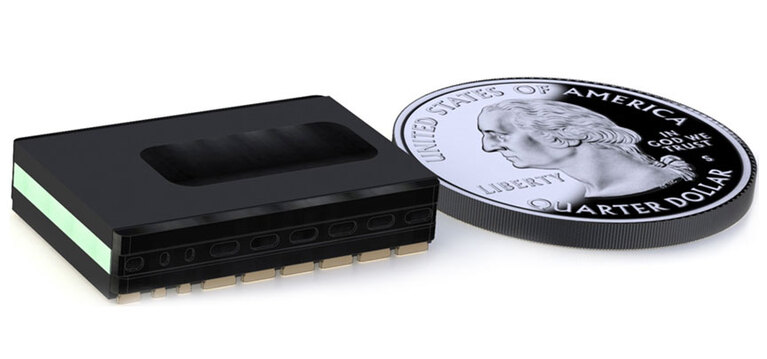
One example of advanced packaging that improves power processing and delivery performance is the Converter housed in Package (ChiP) technology from Vicor. ChiP-based devices exploit symmetrical configurations placing dissipative devices on both sides of a central PCB. A thermally conductive encapsulant transfers heat to both the top and bottom surfaces effectively doubling the cooling surface area relative to the device’s PCB footprint (Figure 1). With appropriate system PCB design, additional heat can conduct through the electrical contacts as well.
Figure 1: Advanced packaging technologies, such as Vicor ChiP, support symmetrical thermal designs exploiting top- and bottom-side cooling
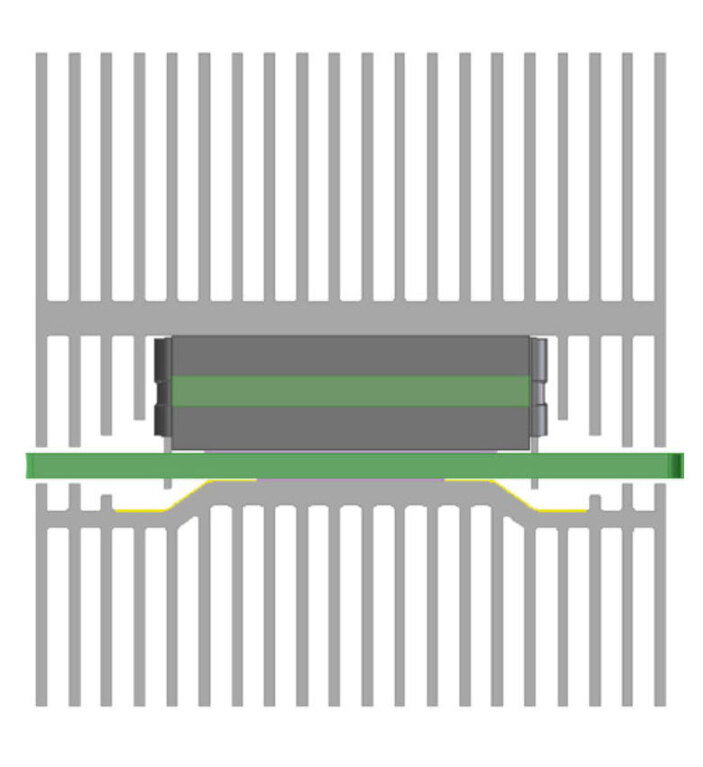
A combination of high efficiency—97.5% peak for 380 to 12V bus converters—and symmetrical thermal design with advanced materials can provide 1.5kW. Including heat sinks and a fan assembly, a 40 x 40 x 100mm assembly offers a power density of 9.4W/cm3 (Figure 2).
Figure 2A: Cross-section of heatsink enabling top- and bottom-side cooling
Advanced packaging technologies such as this provide 3-D thermal management schemes in either surface mount or through-hole mount form factors. Integrated magnetics promote designs requiring few external components, saving design-cycle time, circuit board area, and product assembly costs.
The encapsulant promotes efficient heat transfer while providing a level of safety insulation commensurate with high-voltage power management requirements and international safety standards. This allows the same packaging technology to apply to a wide range of power management functions. These include AC-DC conversion with power-factor correction; isolated bus conversion; DC-DC conversion; buck, boost, and buck-boost regulation; and POL current multiplication. A single packaging technology that is applicable to the full menu of power management tasks from power entry to PoL can also simplify system thermo-mechanical design by unifying device profiles and thermal characteristics.
Capabilities and scaling vary among various power component manufacturers, so check your vendors’ offerings carefully. In the case of Vicor ChiP-based components, devices can attain thin profiles to 4.7mm and footprint areas from 6 x 23mm to 61 x 23mm, and expanding. Current capabilities extend to 180A and operating voltages to 430V, and rising. The company has demonstrated power delivery capabilities in this package technology as great as 1.5kW, and that number is set to increase as well.
In lower-power applications such as POL converters, small-footprint, low-profile packages provide system designers with additional flexibility to minimize trace lengths from power converter to load. When powering digital resources characterized by high dynamic currents, such as ASICs, processors, or memory subsystems, low loss and low inductance power feeds ensure tight regulation and rapid transient response measured at the load, where it counts.
This type of packaging technology also supports high voltage-ratio converters, which in some applications can allow designers to eliminate an entire conversion stage, reducing system cost, increasing the power-train’s end-to-end operating efficiency, and increasing reliability.
Figure 2B: Power management devices taking advantage of advanced packaging can deliver as much as 1.5kW from cells measuring less than 10 in3 including heatsinks and fan
ReVolt – 技術問答
ReVolt 正在解决好莱坞片場的排放問題,下一步將把可擕式 DC 電源應用於建築工地、應急回應事件等領域
雙向供電與快速瞬態回應能力賦能可擴充的主動懸架系統
正弦振幅轉換器™ (SAC™) 模組憑藉其獨特的雙向供電功能與瞬態回應速度組合,為主動懸架系統開闢了全新可能性
提供更高的峰值功率和更快的動態瞬態回應,實現更輕、更强大的電動汽車架構
隨著時間的推移,市場上的電動汽車(EV)對電驅動系統的依賴程度日益加深,例如線控轉向、線控制動以及主動懸架系統等
電流倍增器:為 AI 處理器及其他嚴苛應用供電的明智之選
AI 處理器需要解决低電壓、高電流的嚴苛挑戰,這將會導致電源系統設計產生瓶頸。瞭解 Vicor 的電流倍增技術如何改變這一現狀