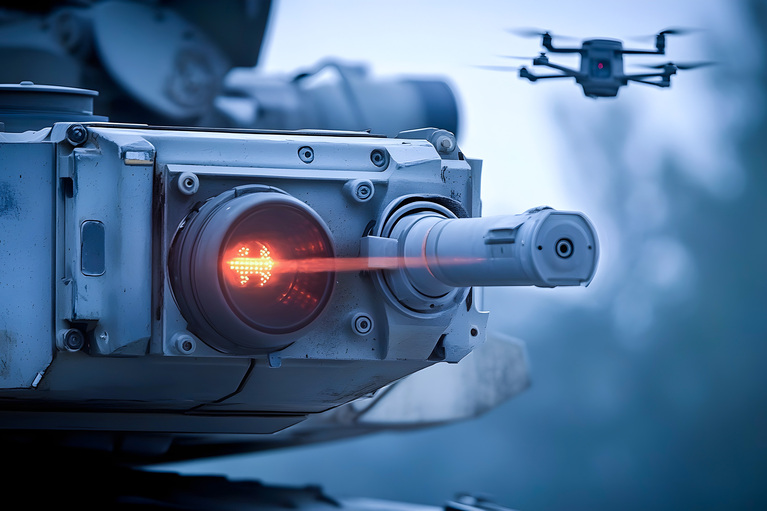
Power averaging for counter-UAS systems delivers speed and reliability
Power averaging enables compact, lightweight C-UAS systems by pairing current-limiting DC-DC converters with capacitors to deliver peak pulses reliably


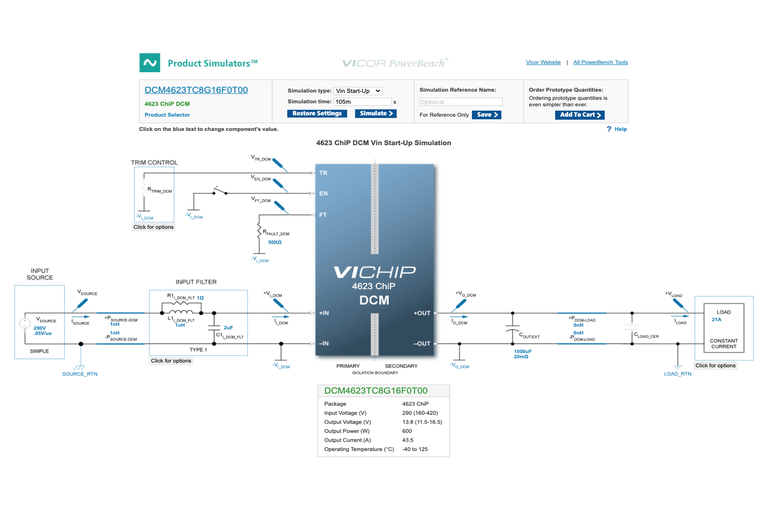
Knowing exactly how power components will behave is crucial if engineers are to be able to develop power systems that work as intended on the first revision. Our online simulator tool provides precision modeling of electrical and thermal behavior for a range of our products, enabling engineers to understand exactly how they will operate in a real application.
This online simulator tool allows the user to define the operating and environmental conditions: in addition to setting the basic Line and Load conditions, the user can also adjust input and output impedance and filter conditions. A range of products are supported by the simulator, including DCMs, BCMs, PRMs, PFMs and Intermediate Bus Converters (IBCs). Currently over 50 standard Vicor power components are supported. The tool will simulate input voltage startup, EN startup, steady state operation, EN shutdown, a step change in the load and a step change in input voltage. This allows power system designers to understand the operation of the component in a wide range of different situations. The simulator allows the values of filter and other peripheral components to be modified, and the user can select the duration of the simulation. When the simulation is run, the tool produces detailed voltage and current waveforms to show the behavior at various points in the circuit that are selectable by the user.
The Vicor online simulator tool is a valuable tool that provides a detailed analysis of the operation of many of the Vicor power components, making it easy to model the performance of your system.
Power averaging for counter-UAS systems delivers speed and reliability
Power averaging enables compact, lightweight C-UAS systems by pairing current-limiting DC-DC converters with capacitors to deliver peak pulses reliably
Current gain and current density essential to power AI today: Patrizio Vinciarelli interview
Patrizio Vinciarelli, CEO of Vicor shares insights on powering AI today and its extraordinary current demands and the need to easily scale
Revolt is tackling the film industry’s dirtiest production secret - CO2 emissions
ReVolt Fuel tackles the film industry emitting 700k tons of CO2 per year to deliver clean on-set electricity with help of Vicor power modules
Powering AI Processors using a 48V Factorized Power Architecture™
Using a 48V Factorized Power Architecture™ to overcome traditional multiphase limitations and drastically cut I²R thermal losses for high-demand loads