
VIPAC Array™ family
VIPAC Array™ DC Configurable Power Supply
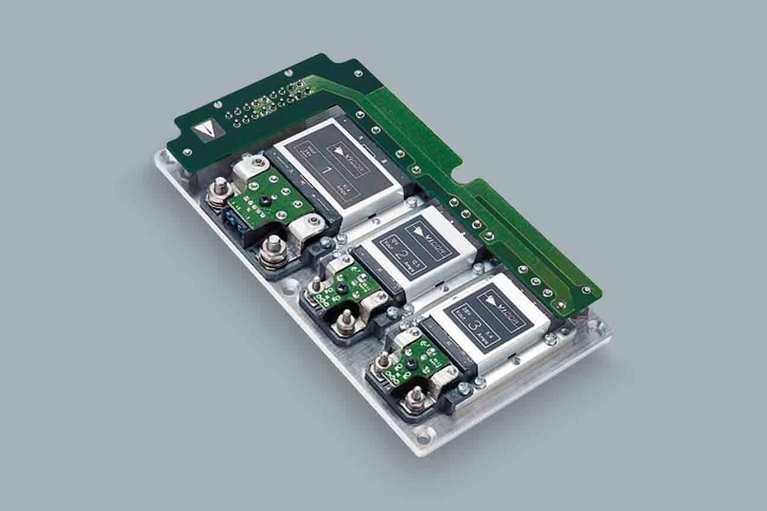
The VIPAC Array is a highly flexible system of DC input, power building blocks that can be configured with as many as four user-definable outputs on a low-profile, coldplate chassis. Using the Vicor PowerBench™ configuration tool, designers are able to specify VIPAC Arrays with inputs of 24, 28, 48, 72, 110, 150, 300 or 375VDC and outputs from 2 to 54VDC at power levels up to 600W per output. VIPAC Arrays are ideal for use in distributed and modular power systems where power density and reliable operation are critical.
A current-share option is available on single-output models enabling them to be used in applications requiring high power/redundancy. Fully connectorized input and output terminations speed system installation and a versatile coldplate chassis simplifies thermal management.

Power System Designer
Features and Benefits
Features and benefits
Single, dual, triple & quad outputs
Fully connectorized
input & output for simplified hook up

Rugged, low-profile, coldplate chassis
High-temperature capability
Resources
Resources for the design engineer

Powering AI Processors using a 48V Factorized Power Architecture™
Using a 48V Factorized Power Architecture™ to overcome traditional multiphase limitations and drastically cut I²R thermal losses for high-demand loads
11 ways to fine tune your high-voltage-to-48V power conversion
Converting high-voltage to 48V DC slashes cabling costs and weight, significantly boosting energy efficiency across data centers and industrial systems

ReVolt is cleaning up the film industry
ReVolt replaces noisy diesel generators on film sets with a clean mobile battery system
- cURus – UL 60950-1, CSA 60950-1
- cTÜVus – EN 60950-1, UL 60950-1, CSA 60950-1
- CE Mark – Low Voltage Directive (2014/35/EU)
- CE Mark – Low Voltage Directive (2014/35/EU) and RoHS Recast Directive (2011/65/EU)
- CB Certificate – IEC 60950-1
- Outline drawing for VIPAC Array Configuration "A"
PDF DXF - Outline drawing for VIPAC Array Configuration "B"
PDF DXF - Outline drawing for VIPAC Array Configuration "C"
PDF DXF - Outline drawing for VIPAC Array Configuration "D"
PDF DXF - Outline drawing for VIPAC Array Configuration "E"
PDF DXF - Outline drawing for VIPAC Array Configuration "F"
PDF DXF - Outline drawing for VIPAC Array Configuration "G"
PDF DXF - Outline drawing for VIPAC Array Configuration "H"
PDF DXF
- Using LugMate, 1 Output
STEP 3D PDF - Using LugMate, 2 Outputs
STEP 3D PDF - Using PlugMate, 1 Output
STEP 3D PDF - Using PlugMate, 2 Outputs
STEP 3D PDF - Using LugMate, 2 Outputs
STEP 3D PDF - Using LugMate, 3 Outputs
STEP 3D PDF - Using PlugMate, 2 Outputs
STEP 3D PDF - Using PlugMate, 3 Outputs
STEP 3D PDF - Using LugMate, 2 Outputs
STEP 3D PDF - Using LugMate, 3 Outputs
STEP 3D PDF - Using PlugMate, 2 Outputs
STEP 3D PDF - Using PlugMate, 3 Outputs
STEP 3D PDF - Using LugMate, 1 Output
STEP 3D PDF - Using PlugMate, 1 Output
STEP 3D PDF - Using LugMate, 2 Outputs
STEP 3D PDF - Using LugMate, 3 Outputs
STEP 3D PDF - Using PlugMate, 2 Outputs
STEP 3D PDF - Using PlugMate, 3 Outputs
STEP 3D PDF - Using LugMate, 2 Outputs
STEP 3D PDF - Using LugMate, 3 Outputs
STEP 3D PDF - Using LugMate, 4 Outputs
STEP 3D PDF - Using PlugMate, 2 Outputs
STEP 3D PDF - Using PlugMate, 3 Outputs
STEP 3D PDF - Using PlugMate, 4 Outputs
STEP 3D PDF - Using LugMate, 1 Output
STEP 3D PDF - Using PlugMate, 1 Output
STEP 3D PDF - Using LugMate, 1 Output
STEP 3D PDF - Using LugMate, 2 Outputs
STEP 3D PDF - Using PlugMate, 1 Output
STEP 3D PDF - Using PlugMate, 2 Outputs
STEP 3D PDF
Promo Component
Related Products
Related Products

The DC-DC converter that established the “brick” standard