

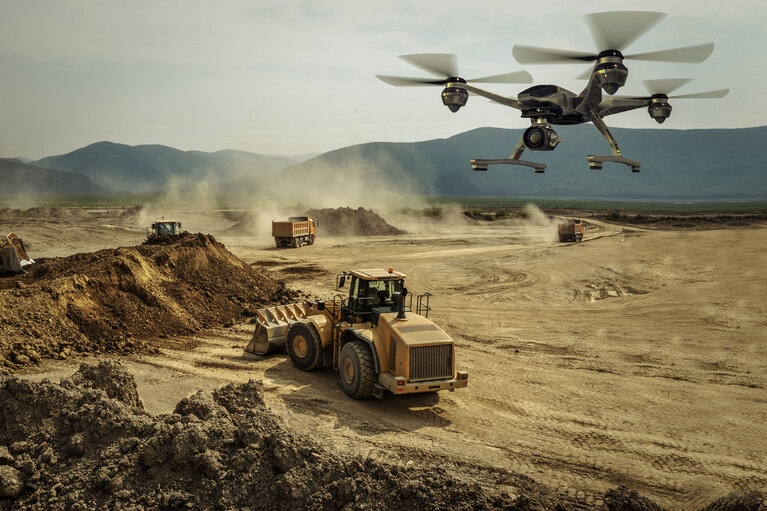
Extend flight times and support high-performance surveillance equipment to ensure safety and security


High power density and weight

High voltage

Low EMI
Responding quickly to natural disasters and restoring communications is important to reinstating the supply line of essential services such as drinking water, food, and electricity. This enables first responders to support the time-critical needs of victims and helps ensure their safety. Lack of mobile communication frustrates restoration efforts putting lives at risk.
Fukaden, a power supply and drone manufacturing company in Japan, develops a tethered drone with a communication base station to deliver internet and mobile phone services in the wake of natural disasters. This helps to quickly overcome communication barriers, enabling those in jeopardy access to critical support services. Powered by portable generators, these lightweight drones can be deployed with first responders to facilitate communications around needed supplies and human services.

Low noise

High density

High efficiency
Critical to the performance of the drone is its ground and drone-embedded power delivery network. Fukaden’s power control BOX II main power supply for the land power network delivers power via a tether to the drone and can be scaled using units in parallel to triple the power to 3kW. This added power enables the wireless communication base stations to be mounted on the drone to expand cellular services to a 10km diameter area.
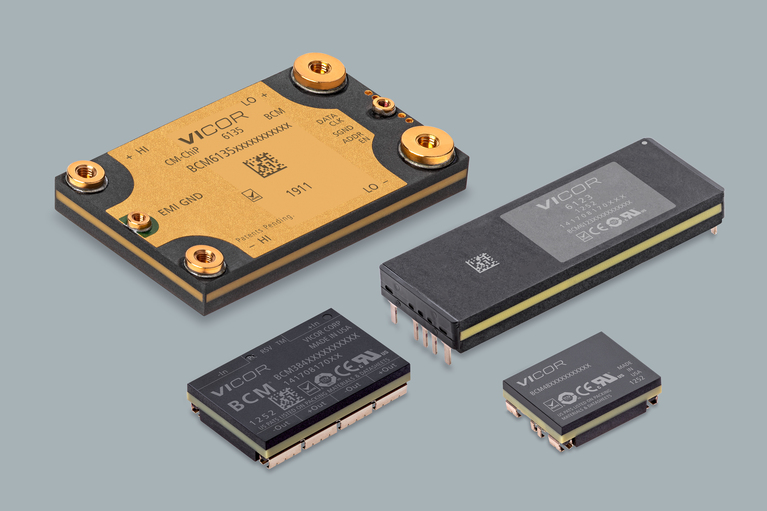
Fukaden’s drones require power that ranges from 1kW to 5kW. Simular to other UAV solutions, Fukaden was able to minimize the size and weight of the tether cable by using higher voltage power, which reduced current. By increasing the tether voltage to 370VDC from 24VDC, the 1kW tether cable weight was reduced 11X, from 125g to 11.1g per meter. This valuable space and weight savings contributes to less drag and better performance. To support the added weight of the communication base station Fukaden deployed higher voltage (700V), a thinner tether and used three high voltage Vicor BCM fixed ratio converters in parallel. This delivered the extra power needed support, payload, duration and communication services.

Fukaden was able to minimize the size and weight of the tether cable by using higher voltage power, which reduced current. By increasing the tether voltage to 370VDC from 24VDC, the 1kW tether cable weight was reduced 11x, from 125g to 11.1g per meter.

Fukaden’s next generation communication station requires up to 9kW. Using higher voltage power (DC 700V), thinner cabling and an array of three Vicor BCMs in parallel Fukaden was able to easily scale the power to deliver better performance. With the added power, the drone can fly for 92 hours and maintain a communication area diameter of 10km.
Isolated fixed-ratio
Input: 36 – 800V
Output: 2.4 – 55.0V
Current: Up to 150A
Peak efficiency: 98%
As small as 22.0 x 16.5 x 6.7mm
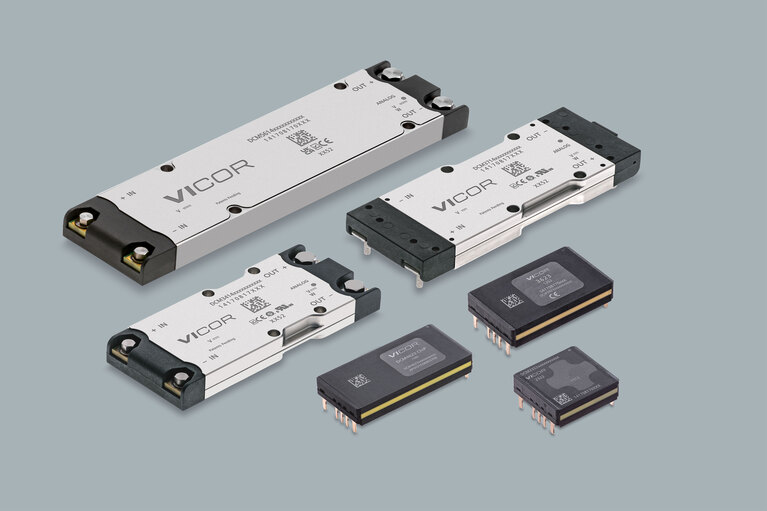
Isolated regulated
Input: 9 – 420V
Output: 3.3, 5, 12, 13.8, 15, 24, 28, 36, 48V
Power: Up to 1300W
Peak efficiency: 96%
As small as 24.8 x 22.8 x 7.21mm
Extend flight times and support high-performance surveillance equipment to ensure safety and security
64% power reduction from power averaging
Simple, redundant power assures uninterrupted aircraft safety
Configurable VITA 62 compliant system adapts to specific power requirements


