
Power averaging for counter-UAS systems delivers speed and reliability
Power averaging enables compact, lightweight C-UAS systems by pairing current-limiting DC-DC converters with capacitors to deliver peak pulses reliably


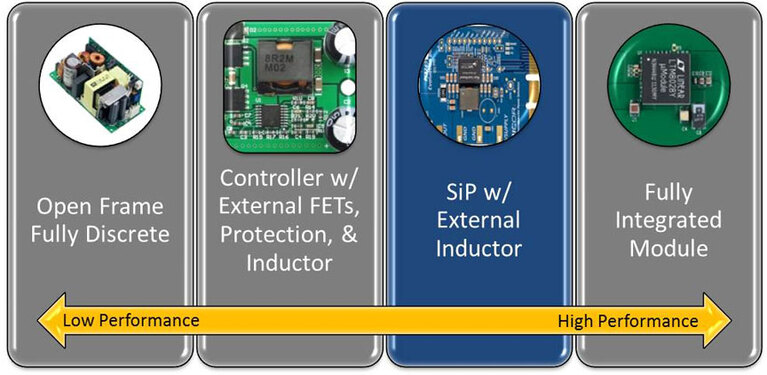
Switching regulator solutions are offered in various levels of integration, offering a broad spectrum of performance, features, and packaging. They range from open frame discrete solutions to fully integrated modules.
Figure 1. Different levels of Integration in Regulator Solutions
Figure 1. Different levels of Integration in Regulator Solutions
There are numerous tradeoffs to each type of design, but the one that takes the lead in performance vs. cost for the 50W to 100W-type point-of-load design is the SiP-type regulator, especially when combined with a ZVS switching topology. These SiP-based regulators, like our Vicor ZVS regulators, are built on an over-molded substrate, which integrates power FETs, passive components, and predefined compensation components. This packaging approach integrates the majority of the regulator system except for the inductor and input/output capacitors.
With an external inductor, board-level heat dissipation is superior vs. the module approach where heat is concentrated in one location (the inductor can generate 40-50% of the total regulator heat). Without being constrained by package profile limitations external inductor design can be optimized for efficiency. Lower switching losses of the Vicor ZVS topology translate into higher efficiency, lower heat dissipation, and higher density. On the cost side, competitive modules from various IC vendors, including Vicor, typically hold a 1.5x to 3x premium over SiP-based regulators.
Considering that module performance lags vs. SiPs, and they cost more, designers might ask if the modules’ small gains in density are really worth it. At least for the Vicor-based SiP regulators, our density (power delivery vs. x-y board area consumption) is on par with modules, even when including all the required components (the external inductor and input/output capacitors). This is because the modules also require external input/output capacitance. Vicor’s ZVS topology supports high frequency operation (without sacrificing efficiency) and this allows for smaller passives.
Applications vary and hence there is a need for various levels of regulator integration, however, when looking at efficiency, size, and cost, our ZVS regulators set a performance/cost metric that surpasses that of many fully integrated modules. This can be counter intuitive to many designers especially when not aware of the added benefits of a ZVS switching topology regulator.
Related content
Product overview: ZVS buck switching regulators
Power averaging for counter-UAS systems delivers speed and reliability
Power averaging enables compact, lightweight C-UAS systems by pairing current-limiting DC-DC converters with capacitors to deliver peak pulses reliably
电流倍增与电流密度对当今人工智能供电必不可少:Patrizio Vinciarelli 访谈
Vicor 首席执行官 Patrizio Vinciarelli 分享了当今为 AI 供电的见解,轻松扩展以及卓越的电流需求
ReVolt 正在攻克电影行业最不愿公开的污染问题——二氧化碳排放
ReVolt Fuel 解决了电影行业每年排放 70 万吨二氧化碳的难题,在 Vicor 电源模块的帮助下提供清洁的现场电力
采用 48V 分比式电源架构™为 AI 处理器供电
采用 48V 分比式电源架构™ 克服传统的多相方案限制,显著降低了高需求负载下的 I²R 热损耗