Powering AI processors – 48V vertical power delivery changes the game
AI models demand huge current, driving legacy multiphase designs past 50 phases—causing space, thermal, and control limits Vicor addresses


When electronic equipment is connected to the AC mains, it has the potential to generate common-mode electrical noise. If this is allowed to flow back on to the mains supply line, it can disturb other equipment also connected to the same line.
Manufacturers design capacitor-based power line filtering into their systems to decouple any such common-mode noise produced by the equipment’s power supply, preventing it from reaching other equipment through the mains power line. The reliability of these capacitors is critical to the safety of the equipment’s users.
Line filter capacitors are classified either as X-capacitors or Y-capacitors. X-capacitors are connected between line and neutral, to protect against differential mode interference. Their failure does not create conditions for dangerous electric shock, although it can create a fire risk. However, Y-capacitors are designed to filter out common-mode noise, and are connected between line and chassis; if they short-circuit, they create a risk of shock to the user.
Y-capacitors are designed to enhanced electrical and mechanical reliability standards. Capacitance values are also limited to reduce the current passing through the capacitor when AC voltage is applied, and reduce the energy stored to a safe limit when DC voltage is applied. Capacitors must be tested to applicable standards to qualify them for use as Y-capacitors.
The EN 132400 Standard was issued on 26 June, 1995 replacing all the European National Standards in force up to that date. This was identical to the International Standard IEC 60384-14 2nd Edition 1993. Since then, to make CENELEC and IEC standards identical in name as well as specification, the European Standard EN 132400 has been superseded by EN 60384-14 that is identical to the International Standard IEC 60384-14. Any European national body can issue approvals, with validity recognized by the bodies of all the other CENELEC member countries with no need to repeat the tests.
USA: UL 1414 for across the line applications and UL 1283 for Electromagnetic Interference filters Canada: CAN/CSA C22.2N°1 and CAN/CSA 384-14 China: GB/T14472
EN 60384-14 defines sub-classifications for both types. X1 capacitors are used for high pulse applications, while X2 and X3 types are used for general-purpose applications with different peak pulse operating voltages and peak value surge voltages. Y-capacitors, which are used to bridge operational insulation, are classified as Y1, Y2, Y3 or Y4 according to type of bridged insulation as well as AC and peak voltage ratings. Y1 class capacitors are rated up to 500VAC, with a peak test voltage of 8kV. Y2 capacitors have 150 to 300VAC ratings and a peak test voltage of 5kV. Y3 capacitors are rated to 250VAC with no peak test voltage specified. Y4 capacitors are rated to 150VAC with a peak test voltage of 2.5kV.
These include impulse voltage, endurance and active flammability tests. Application and parameters for these tests depend on the capacitor classification and sub-classification.
Two common types are metallised paper/film and ceramic. For Y-capacitors, ceramic types are less expensive than metallised film, but unstable over time and temperature and less mechanically stable. Ceramic failure mode also tends toward short circuit, whereas metallised paper and film types tend towards open circuit.
Vicor products including FARM, ARM and AC Front End have filters that include Y-capacitors. Refer to the FARM Design Guide and Application Manual for an example of an integral input filter comprising a common-mode choke, Y-capacitors and X-capacitors.
Powering AI processors – 48V vertical power delivery changes the game
AI models demand huge current, driving legacy multiphase designs past 50 phases—causing space, thermal, and control limits Vicor addresses
Innovative 48V AI power architecture delivers both high current density and high current gain
Vicor 48V Factorized Power Architecture slashes thermal losses and delivers high current density to meet the extreme power demands of AI processors
48V Factorized Power Architecture™ slashes thermal losses and outperforms multiphase approach when powering AI
AI hardware faces severe power and cooling limits. Engineers debate 48V vs. 6V intermediate buses alongside new vertical power delivery (VPD) structures
Betterfrost: Putting on the heat
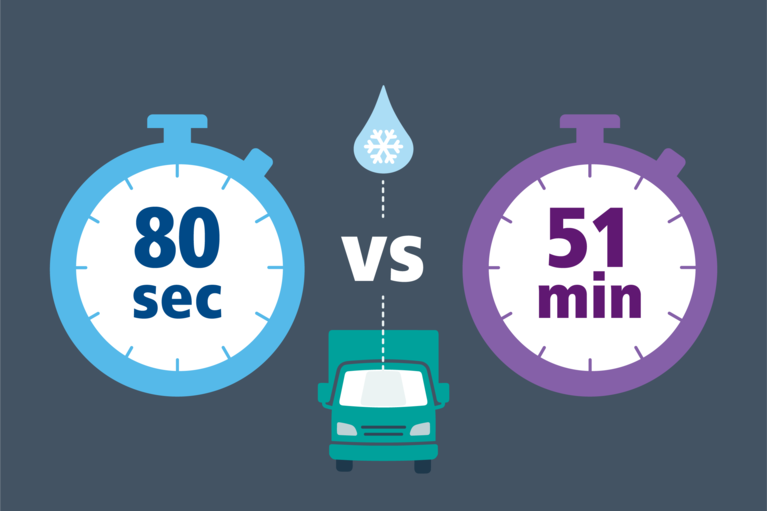
Betterfrost uses a 48V module for pulsed, conductive glass heating, clearing ice in under 80 seconds while cutting start-up defrost energy by 95%