
ReVolt – 技术问答
ReVolt 正在解决好莱坞片场的排放问题,下一步将把便携式 DC 电源应用于建筑工地、应急响应事件等领域
尊敬的用户:
为了改进 Vicor 网站,我们将于美国东部时间 12 月 29 日上午 11:30 至下午 2:00 对网站进行维护。
在此期间,您可能无法查看网站的某些部分,特别是产品页面和产品型号列表。
对于给您带来的不便,我们深表歉意,并感谢您的耐心等待。
– Vicor 网站团队
Buck voltage regulation, an essential part of distributing power from a DC supply to its points of load (PoLs), has typically been implemented with a PWM circuit. The PWM duty cycle is varied to accommodate the required voltage reduction.
However a couple of factors have applied increasing pressure to regulator design. Firstly, power density is being forced up as continuously more powerful devices are designed onto boards without corresponding increase in footprint. Secondly, DC power supply voltage levels are tending to rise to minimize distribution losses, while device voltages are reducing to increase internal speed and efficiency. These trends combine to increase the voltage drop and associated switching losses across the regulator.
For example a process control system may call for regulation from 24V to 3.3V – a gap that would typically be covered using two regulation stages; increasing board space, cost and reliability issues. The regulator’s switching frequency is also limited, as increased switching activity incurs more losses. This in turn limits the use of smaller passive components for filtering, penalizing the density of the total solution.
Although high-density PWM regulators have evolved with improved IC integration, MOSFETs and packaging, their design is no longer sufficient to meet the power demands they face. This is mainly due to switching losses within the regulator MOSFETs. These must be overcome or avoided to achieve any significant boost to regulator performance.
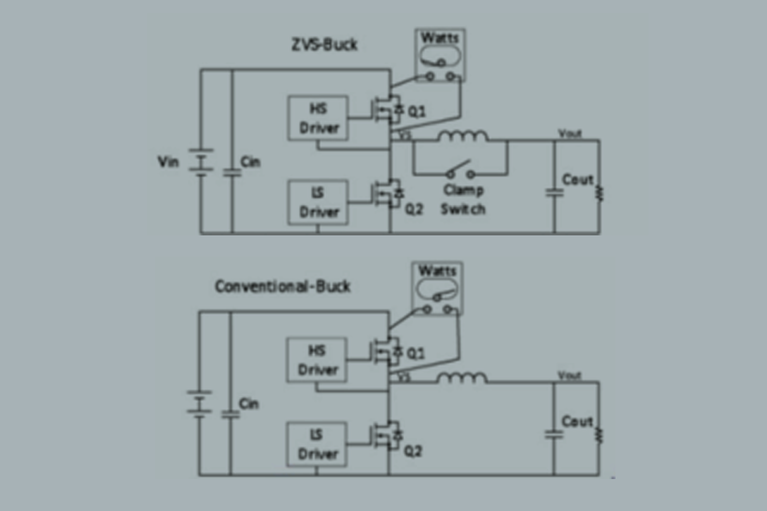
A better solution uses zero-voltage-switching (ZVS) topology, which allows for operation at a higher frequency and at higher input voltages without sacrificing efficiency. While still PWM based, a separate phase is added to the PWM timing to allow for ZVS operation. Figure 1 compares a conventional buck regulator with a version modified for ZVS operation. Utilizing the added phase, the ZVS type uses the clamp switch and circuit resonance to operate the high side (Q1) and synchronous (Q2) MOSFETs efficiently with soft switching, avoiding the losses they incur during conventional PWM operation and timing.
For example in the conventional circuit, as Q1 is turned on and Q2 turned off, a very high current flows through the MOSFET pair, since Q2’s body diode appears as a short circuit during its reverse recovery time. Other losses arise due to discharging Q1’s output capacitance, and to reverse recovery in Q2. These losses increase as the switching frequency or input voltage increases.
By contrast the ZVS design addresses the high turn-on losses of the conventional regulator by eliminating high current body diode conduction prior to turn on of the high-side MOSFET, bringing the D-S voltage of the high side MOSFET to zero or nearly zero and producing no high current spikes or damaging ringing. The ZVS action applied to Q1 removes its Miller effect at turn on, allowing the use of a smaller driver and lower gate drive.
Vicor has utilized ZVS topology within our buck regulators. These provide regulation up to 36VIN at a higher efficiency and from a smaller form factor than achievable from conventional hard switching, high density regulators.
Figure 1: ZVS Buck
Related content
Product overview: buck regulators
ReVolt – 技术问答
ReVolt 正在解决好莱坞片场的排放问题,下一步将把便携式 DC 电源应用于建筑工地、应急响应事件等领域
双向供电与快速瞬态响应能力赋能可扩展的主动悬架系统
正弦振幅转换器™(SAC™)模块凭借其独特的双向供电功能与瞬态响应速度组合,为主动悬架系统开辟了全新可能性
提供更高的峰值功率和更快的动态瞬态响应,实现更轻、更强大的电动汽车架构
随着时间的推移,市场上的电动汽车 (EV) 对电驱动系统的依赖程度日益加深,例如线控转向、线控制动以及主动悬架系统等
电流倍增器:为 AI 处理器及其他严苛应用供电的明智之选
AI 处理器需要解决低电压、高电流的严苛挑战,这将会导致电源系统设计产生瓶颈。了解 Vicor 的电流倍增技术如何改变这一现状